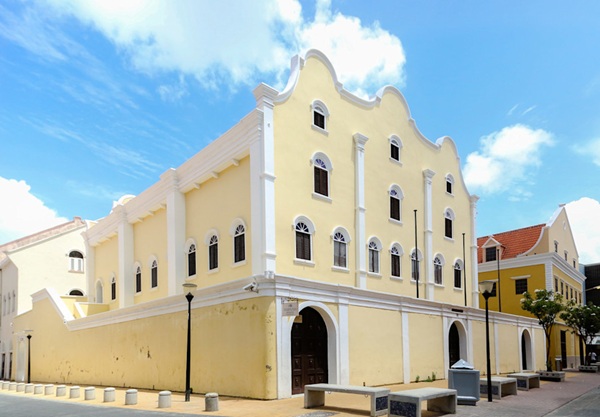
The first Jew to arrive in Curaçao was Samuel Cohen, who served as an interpreter aboard the Dutch fleet that conquered the island from the Spanish in 1634. A few years later, in 1651, Joao d’Ylan brought 10 to 12 Jewish families from Amsterdam’s Portuguese community to Curaçao. They settled on Plantation ‘De Hoop’ (The Hope) and worked the land, establishing Congregation Mikvé Israel-Emanuel, which is today the oldest synagogue in continuous use in the Americas.
A second group of settlers arrived in 1659 under the patronage of Isaac da Costa. They brought with them a precious gift from the Amsterdam synagogue: a Torah scroll that is still used today in the Mikvé Israel-Emanuel Synagogue.
Most of these early settlers were originally from Spain and Portugal. They had fled the Inquisition and found refuge first in Holland and Northern Brazil before making their way to Curaçao.
The settlers initially tried their hand at agriculture, but the arid soil made farming difficult. By 1660, the Jewish community had concentrated in the walled city of Willemstad, where they established trade routes between Northern Europe and the South American coast. In 1674 they built the first of four synagogues in Willemstad. Some Jews also built plantation houses scattered around the island.
Through the centuries, the Jews of Curaçao flourished in trade, shipping, commerce, and banking, leaving their mark on practically every aspect of life on the island.
The Jews who arrived in Curaçao centuries ago were of Sephardic descent and followed traditional religious rituals and customs. As early as 1651, a synagogue was established on the island, allowing the Jewish inhabitants to continue practicing their religion. The founders of this community were so successful that they sent money to help start other Sephardi communities in South America and Newport, Rhode Island.
Years of living in fear of persecution and searching for a new home undoubtedly shaped the customs and rituals that the newly formed Congregation Mikvé Israel developed when the current synagogue was built in 1732. Those who started the congregation included refugees fleeing the Spanish Inquisition and merchants seeking their fortunes.
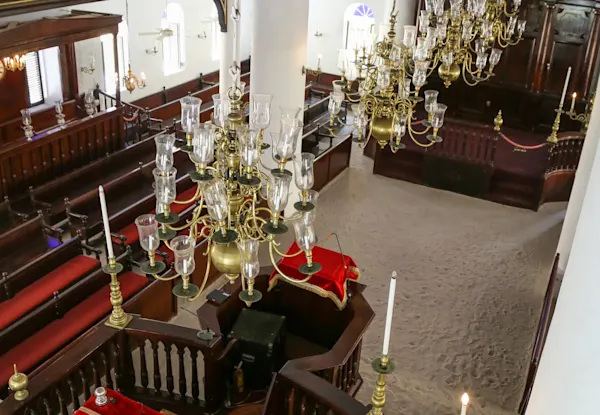
The first synagogue built in Willemstad in 1674 was replaced in 1703 with a much larger building on the same site where the “Snoa” synagogue stands today. This synagogue quickly grew too small for the flourishing community, and a new one was inaugurated in 1732. In 1864, members of the Mikvé Israel congregation who started their own group built the magnificent Temple Emanuel. The now unified congregation of Mikvé Israel-Emanuel, currently affiliated with Reconstructionist Judaism, uses the Snoa, the oldest synagogue in continuous use in the Americas. Its remarkable architecture, solid mahogany interior, 18th-century copper chandeliers, and sand-covered floor have made it one of the most cherished monuments and the number one tourist attraction in Curaçao.
United Congregation Mikvé Israel-Emanuel in Curaçao, Netherlands Antilles, is the oldest active Jewish congregation in the Americas. Founded in 1651, the congregation has functioned continuously for more than 350 years. Today, Congregation Mikvé Israel-Emanuel continues to follow Western Sephardic rites. The majority of its members are descendants of the Sephardic Jews who originally settled on the island.
The Jewish Museum is located inside the Mikvé Israel synagogue. On display are religious objects from the early days on the island, including a set of circumcision chairs, a Passover table set for the Seder, baby-naming and circumcision clothes, spice boxes, candlesticks, Torah covers, and remains from a 1728 mikvah. The community had unique customs, including a special black tallit for the rabbi on Tisha B’Av, black shoes and a black yad for the person reading from Lamentations. Another distinctive custom from the Caribbean community is the practice of throwing the wine glass at a platter during the wedding ceremony, leaving a permanent mark on the platter.
In the first cemetery at Curaçao, a gourd with an egg sits in front of the tomb. According to Caribbean tradition, this custom shows that the larger community wants to include Jewish prayers in the cemetery. Today, Mikvé Israel-Emanuel claims to own 18 Torah scrolls over 300 years old. A few may have been brought by the same men who fled the Inquisition in the late 1400s and founded the community in Curaçao.
By the end of the eighteenth century, Jews constituted more than half of the white population in Curaçao. While their principal language had been Portuguese, many Jews spoke Papiamentu amongst themselves, enriching the native language of the island with Portuguese and Hebrew words.
At the turn of the nineteenth century, the Jews of Curaçao became involved with Simon Bolivar and his fight for the independence of Venezuela and Colombia from their Spanish colonizers. Two Jewish men from Curaçao distinguished themselves in Simon Bolivar’s army, while another supplied moral and material support to Bolivar, as well as refuge for him and his family.
Even today, the Senior Curaçao liqueur is still manufactured by a Jewish family, as are many of the other main businesses on the island, including Maduro and Curiel’s Bank and Gomez Enterprises.
The Jews of Curaçao also left their mark on the architecture of the island. The two synagogues established in town (both still standing) are prime examples of monumental Jewish buildings. Many of the buildings in Willemstad were built by Jewish businessmen, as were several of the grand mansions in Scharloo and Pietermaai. These buildings reflect the elaborate lifestyle of the Jews at the turn of the twentieth century. Jewish families built homes here so they could easily sail to town. Later the Jews moved to the suburbs, where they continued to be innovative in architecture.
Throughout their history in Curaçao, Jews have been involved in practically all facets of life, from pioneering efforts in commerce, industry, and tourism to social causes, community service, politics, academics, and the arts.
Today, tourists can visit Curaçao’s Jewish Museum, which is connected to the Mikvé Israel-Emanuel synagogue. The museum features religious artifacts such as centuries-old circumcision chairs, a Passover table, remains from a 1729 mikveh, as well as the 18 Torahs from the synagogue.
The agriculture practiced by the first Jewish settlers in the seventeenth century was not economically viable, and soon the Jews of Curaçao pursued opportunities in trade. The Spanish colonizers were not providing well for their territories on the South American coast, and the Jews started a continuous trade between the region and the European continent. Soon thereafter, Jews opened shops in Willemstad, where they traded goods from both continents.
In this underdeveloped region, the Jewish community excelled with their knowledge of international trade, shipping and maritime insurance, and transportation. Their family and ethnic connections with Jewish businessmen, financiers, and industrialists in world centers like Amsterdam, Hamburg, London, Bordeaux, Lisbon, Madrid, and New York allowed them to capture most of the trade in the Caribbean. It should be noted, however, that very few Curaçao Jews were involved with the slave trade, which was primarily the domain of the Dutch.
Shipping became a mostly Jewish domain, as did insurance and insurance brokering. During the first half of the nineteenth century, several Jewish firms were incorporated, providing a combination of commercial, maritime, industrial, and financial services internationally. Three commercial banking institutions evolved out of these early commercial firms.
On May 10, 1940, responding to news of the German invasion of the Netherlands, the authorities in Curaçao acted quickly and decisively. All German ships were confiscated, and the crews, totaling almost 500 men, were taken prisoner and sent to an internment camp in Bonaire until after the war. Others considered enemies of the state based on nationality were also deported to Bonaire, including several German and Austrian Jews.
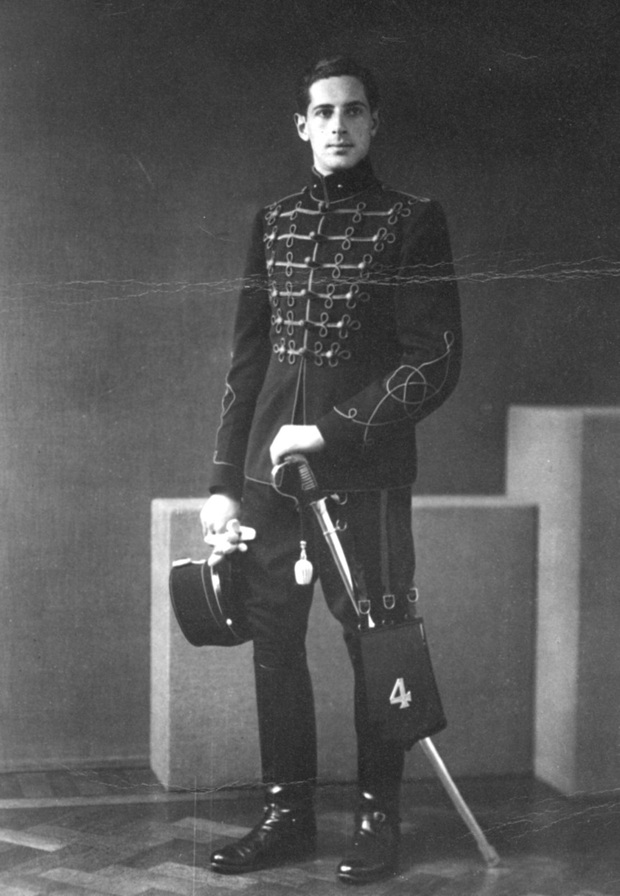
After the war, a monument was erected to commemorate the Antilleans who gave their lives for the war effort, both locally and abroad. A plaque lists 162 names, among them George Maduro. As a reserve officer in the Dutch army, Maduro fought heroically during the war in the Netherlands. After the Dutch capitulated, he joined the resistance to help downed Allied pilots escape via Spain. He was finally arrested by the Germans and perished in February 1945 in Dachau. Madurodam in The Hague, a city park with miniatures of Holland’s landmarks, was built in his memory.
In 1659, with the arrival of the second group of Jewish settlers, the cemetery Beth Haim was consecrated. The oldest tombstone dates from 1668, making it one of the first cemeteries in the New World. This historic cemetery is located about twenty minutes from Willemstad.
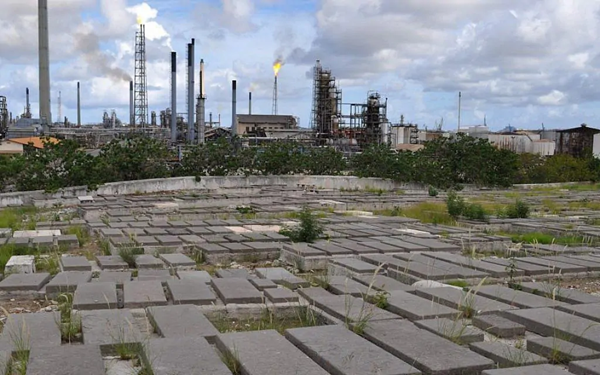
The cemetery contains 2,500 graves, with many of the tombstones adorned with beautiful sculptures representing biblical passages, often relating to the deceased’s name. The most common designs are depictions of biblical scenes related to the name of the deceased. On the tombs of males named Abraham, the Patriarch is seen contemplating the stars. On the tombs of males named Elijah, the prophet is seen in a fiery chariot carrying him to heaven. Sometimes the engraving hints at the cause of death, such as a tree being cut at its root, symbolizing an untimely death, or a ship on stormy water, indicating the victim perished at sea.
Mortality among women in childbirth was frequent. On the tomb of Rachel, wife of Yitzhak Pereira, the father is shown handing over the newborn child to another woman before the deceased mother. Approximately one hundred of the 2,500 tombstones from the 17th and 18th centuries are still somewhat visible and readable today. Replicas of some of the elaborate tombstones can be seen at the entrance to the Curaçao Jewish Museum located adjacent to Mikvé Israel-Emanuel Synagogue in Punda.
Originally laid out in open country near the first agricultural settlements belonging to the original Sephardic settlers, the cemetery is unfortunately surrounded today by a large oil refinery, and its stones are perpetually subjected to the deteriorating and corrosive influence of the refinery’s fumes. The last burials held in this cemetery were in the 1950s.
Among the graves, we find some notable Jews buried, including Ribca Spinoza, the half-sister of Baruch Spinoza, who died on January 25, 1695, and Jahacob Alvares Carrea, an assistant of Málaga-born Eliau Lopez, the chief rabbi of Curaçao in 1693, who died on June 25, 1714.
The antiquity, art, and historical heritage make the cemetery at Blenheim an extraordinary international monument.
Many of the gravesites have both Jewish and non-Jewish symbols on them. Skulls and crossbones and hourglasses on the tombstones show the influence of Iberian Jews and more assimilated Jews who brought customs of the larger community to the Caribbean Jewish community.
Another Jewish cemetery built in 1880 has tombstones with more conservative designs, although one can easily see how artistic designs changed over time. In the early days, lower half-circle tombs were built. By the 1700s, when the Jews had become more financially successful, the tombstones were more elaborate and made from marble or other high-quality materials.
References: Ariel Scheib, Jewish Virtual Library.
Commemorating 350 Years (Mikvé Israel-Emanuel Curaçao, N.A.)
Moment Magazine, “Jewish Paradise in the Caribbean?” By Josh Rolnick, (August 2001).
Fein, Judith. “Curacao’s Sandy Attraction.” Jerusalem Report, (January 13, 2003).
Julie Kay, “Synagogues in the Sand.” The Forward (March 2, 2012).